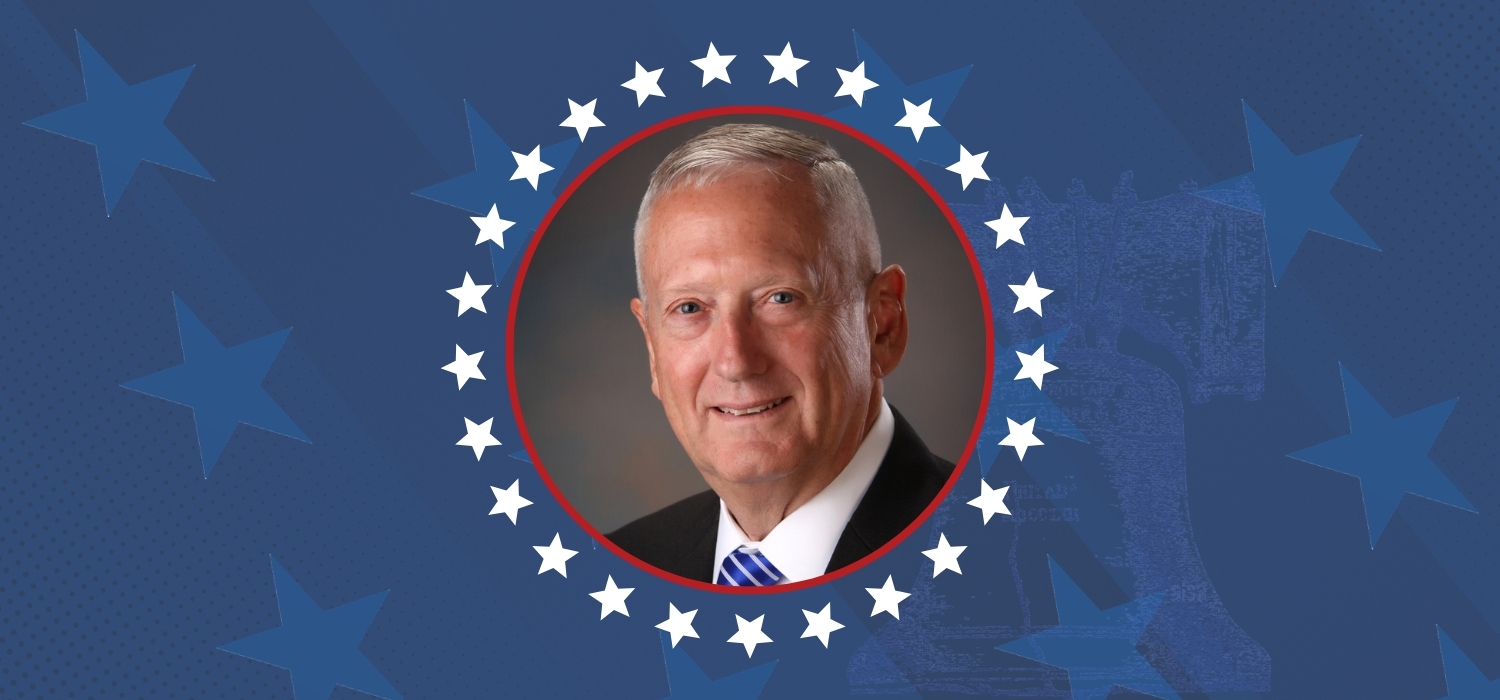
When General James Mattis (Retired) speaks about leadership, he does not begin with management trends or complicated theories. His focus is on people.
The decorated Marine Corps veteran spent more than four decades serving his country. He rose from an 18-year-old Marine Corps Reservist to a four-star general and commander of U.S. Central Command, where he oversaw American forces in the Middle East. He later served as the nation’s 26th Secretary of Defense from 2017 to 2018.
Yet, when Mattis sat down with The MBA Business Magazine to discuss his thoughts on leadership, he focused less on rank and titles than on the experiences, people and books that shaped him. Many of those lessons are explored in Call Sign CHAOS: Learning to Lead, his New York Times bestselling book with Bing West.
At the heart of Mattis’ leadership philosophy is a simple idea. Leadership is tied to service.
“It’s not just about you. It’s putting others first,” he says. “Because if you could do the job without subordinates, they wouldn’t have given you any.”
That idea will be central to Mattis’ keynote discussion at The MBA’s 121st Annual Event on October 7 at the Bayfront Convention Center in Erie, Pennsylvania.
While Mattis’ experience is rooted in the military, the leadership challenges he describes are familiar to organizations of every size. Leaders must build trust, develop employees, make decisions, learn from mistakes and prepare the next generation to take their place.
Leadership is also not about having all the answers or simply giving orders. It is about knowing your profession, knowing your people and creating the conditions for them to succeed.
“You have to demand the most of yourself and devote yourself to your subordinates’ success,” he says.
During his time in the service, Mattis says he could often tell within minutes of arriving at a military location whether a crew was happy or not. “You have a more effective fighting force under a servant leader who creates a happy crew,” he says.
Servant leadership, however, is not about being popular or giving people special treatment. It means earning trust by doing the hard work alongside others and accepting responsibility when circumstances become difficult.
A servant leader, Mattis says, “is not there to have a bigger tent or a more comfortable lifestyle. It means that you lead from the front when it’s uncomfortable or dangerous.”
That approach also shapes how Mattis thinks about authority. Resilient leaders have the responsibility to set standards and make difficult decisions, but their focus should remain on helping the people around them perform at their best.
“They’re always focused on how do they bring out the best in their troops and make successes for the people below them,” he says.
The Path To Service
Mattis, who was raised in Richland, Washington, with ties to western Pennsylvania — his father hails from North Belle Vernon, just outside Pittsburgh — did not enter the military with a long-term plan to become a four-star general. He was 18 when the draft was in place and entered the Marine Corps Reserves largely because that was what was expected of him.
“I was going into the military, the draft was on and that’s all there was to it,” he says. “It was rather unexamined.”
His early experiences in the Marine Corps changed that. He found himself surrounded by Marines he describes as “competent and unselfish and rambunctious.” Rather than leave after his initial commitment, he decided he wanted to remain part of the service after graduating from Central Washington University.
“I decided I’d like to stick with a top flight team and have a great, great team,” he says, which led to his commission as a second lieutenant. “From then on, I focused on how do you keep people motivated,” he notes. “That changed the way I led.”
Competence Matters
Asked what makes a leader resilient, Mattis has a simple answer. Know your profession.
“It’s applied differently in combat or in business. It’s unique to its circumstance,” he says. “But leadership, I think, resilient leaders, no matter what they’re in — a competitive place, marketplace, battlefield, football field, whatever — they’ve got to know their stuff.”
“There’s just nothing that can take the place of competence.”
For Mattis, competence requires leaders to take responsibility for their own development.
His own career reflects that belief. Mattis spent decades studying military history, leadership and the challenges facing the military and the country. He also learned from the people around him.
“I had great non-commissioned officers guiding me, petty officers from the Navy, great commanding officers,” he says. When “I look back, I learned from them all.”
Books provided another source of mentorship. Mattis believes leaders do not have to experience every success or failure themselves. They can learn from the experiences of others.
Marcus Aurelius’ Meditations was one of those sources. “I used to read that book probably before every meeting in the White House,” he recalls.
Leaders Have to Listen
As Mattis explains, competence alone is not enough when it comes to leadership. Leaders also have to listen.
Mattis recalls a description of George Washington by Alexander Hamilton. “General Washington listened so well, he even hears what is not being said.”
For a business leader, that can mean recognizing when an employee raises a concern, noticing when a team is struggling or paying attention when someone who normally speaks freely becomes quiet.
Listening also reinforces trust, which Mattis considers fundamental to leadership. Be consistent.
In addition, a leader who says one thing and does another eventually loses credibility.
“There’s no say-do gap,” he explains.
More Coach Than Commander
Mattis spent much of his career in positions where he had the authority to give orders. But he says giving orders is only a small part of a leader’s job.
He describes his approach as being a “player coach.” “I want to know how to play the game, how to field strip a machine gun, how to bandage a wound, use a radio as well as my troop,” he says. “I wanted to coach them.”
Understanding the work allowed him to lead without trying to do everyone’s job for them. Mattis says the orders he needed to give in a day could often be delivered in five or 10 minutes.
“The rest of the time, you’re really a coach, a teacher, a mentor,” he explains.
Trust Is Earned
Few ideas are more important to Mattis than trust.
“Trust is the coin of the realm when it comes to human relations,” he says. “With trust in the room, we were taught, you can do just about anything. Without it, you can’t do much.”
He compares trust to varnish. It is built layer by layer, but it can be destroyed quickly.
In fact, one of his earliest lessons came from a 22-year-old corporal who served as the senior enlisted leader in Mattis’ first platoon. The corporal offered the young lieutenant some direct advice: “First of all, lieutenant, we don’t do stupid.” Second, “I have my job and you have your job. I won’t try to do yours,” he recalls. “Please don’t try to do mine.”
The lesson was about more than boundaries. It was about delegation and trust.
“I was going to have to delegate to him certain decisions because that was part of his job,” Mattis says. “So this is the first lecture I got, first direction I got when I went out to the fleet.”
Learn From Mistakes
For Mattis, it’s important to distinguish mistakes and failures of discipline or character.
One of the lessons came from a mistake he made as a lieutenant colonel. His commanding officer knew Mattis had made a serious error, but instead of delivering a lengthy lecture, he asked one question.
“Did you learn anything today?”
Mattis said yes.
“OK, good,” the commander replied, and walked away.
The lesson stayed with Mattis because the commander wanted him to recognize the mistake and learn from it. He knew Mattis would soon be facing another difficult situation.
“That was my regimental commander,” Mattis says. “He knew I was going into another fight. He wanted to make certain I learned about it. He wanted to make sure I didn’t deny it.”
That experience helped Mattis understand that mistakes and a lack of discipline require different responses.
“When people make mistakes, I know how to deal with that versus a lack of discipline, which is completely different,” he says. “And there you have to hold people accountable.”
Mattis later applied that distinction with another officer whose behavior had become a problem. He asked the lieutenant to meet him in his running gear, and the two ran for more than an hour in the Mojave Desert in August.
Afterward, Mattis told him that he had been disappointed and that the behavior could not happen again.
“A leader must lead with passion for excellence,” he says, “but you can’t let your passion for excellence submerge your compassion for them as human beings.”
Compassion does not mean lowering expectations. According to Mattis, it means understanding circumstances, distinguishing a mistake from a discipline or ethics problem and responding appropriately.
Leaders also must make expectations clear and confirm that subordinates understand them. “You have to clearly lay out both the mission and your expectations,” he says.
Recognition matters, too. “Most importantly, you want to catch them every time they do something right and tell everybody about it,” he says.
Give People a Purpose
Equally important, according to Mattis, is the military concept of “commander’s intent.”
The idea is to communicate the purpose of a mission, the general method and the desired result without dictating every step. For businesses, that means employees need to understand what their organization hopes to accomplish and why their work matters.
“It starts with defining reality, so they know what it is you exist for, what you’re coming to work for,” he says.
Leaders should be clear about the mission and expectations while leaving room for employees to exercise judgment.
The Marine Corps, Mattis points out, does not use the phrase “command and control.”
“We use command and feedback,” he explains. “We don’t want to control our subordinates. We want to guide them, but we actually want to unleash their initiative and aggressiveness.”
Information must also move clearlythrough an organization. Mattis recalls keeping a small card next to radios and computers in his division of 23,000 sailors and Marines. It asked three questions: “What do I know? Who needs to know? Have I told them?”
The questions were simple, he says, but they reinforced a culture in which information was expected to reach the people who needed it.
Preparing the Next Generation
Succession is another area where Mattis sees a direct connection between military and business leadership.
Organizations need leaders who are actively developing the people who will eventually replace them. Mattis believes leaders should be evaluated in part by how well they develop their subordinates.
“Are they really preparing people to move up?” he asks.
This can mean moving high-performing employees into different roles so they gain broader experience or giving them responsibility before they officially assume a leadership position. Delegation is also critical.
“You have to train them because you don’t want to throw them in and not have them trained, but you have to delegate it to them and watch them making decisions so that you know they’re learning,” he says.
Emerging leaders will not always have complete information or complete confidence. They still have to learn to act.
“A late decision will be worse than no decision right then,” Mattis says.
Additionally, “you make sure that you’re delegating enough decision making to them that their first decision isn’t the day they walk in to fill someone else’s shoes,” he says.
For organizations thinking about succession, Mattis recommends looking at least two levels down to identify people with leadership potential.
“Find them, protect them, and nurture them and have a feedback loop to you that they are actually being developed into leaders,” he says.
That also means listening to people who challenge the organization. The employee who repeatedly raises an uncomfortable issue may be helping prevent a larger problem.
“It’s always better in the military to learn from the guy who keeps needling you about something that needs to be worked on, rather than learning about it from your enemy the hard way,” Mattis says.
Competence, Caring and Conviction
Mattis has spent much of his life in situations where leadership decisions carried serious consequences. His career included combat operations, senior command positions and service as Secretary of Defense. He is known for his candor, strategic thinking and emphasis on empowering others.
Yet when asked what lesson he would most want MBA members to take back to their organizations, families and communities, he returns to the same principle that has shaped his leadership philosophy from the beginning.
“I think it’s that they know they serve,” Mattis says, adding that competence, caring and conviction should define that service. “That should be the mark of every leader.”